



Key Highlights
- Pain on the outside of the knee (lateral knee pain) is commonly caused by iliotibial band syndrome, lateral collateral ligament (LCL) injury, meniscus tears, or osteoarthritis, often due to overuse or injury.
- Symptoms include sharp or dull pain on the outer knee, tenderness, stiffness, clicking, and sometimes instability or difficulty bending.
- Diagnosis involves clinical examination and imaging like X-ray or MRI.
- Treatment typically starts with rest, ice, physiotherapy, and medications, while persistent cases may require injections, regenerative therapies, or surgery depending on severity.
The human knee is a remarkable joint, known for its intricate structure and vital role in our mobility. It’s composed of various components, including bones, ligaments, tendons, and cartilage, all working in harmony to facilitate smooth movement. However, the complexity of this joint also makes it susceptible to a wide range of injuries and conditions, including pain on the outside of the knee. This discomfort can be attributed to several factors, with some of the most common culprits being iliotibial band syndrome, lateral collateral ligament pathology, lateral meniscus tear, rheumatoid arthritis, osteoarthritis, and common peroneal neuralgia. In this comprehensive blog, we will delve into each of the causes, symptoms & treatment options for knee pain, exploring their symptoms, diagnostic procedures, and treatment options.
Understanding Outer Knee Anatomy
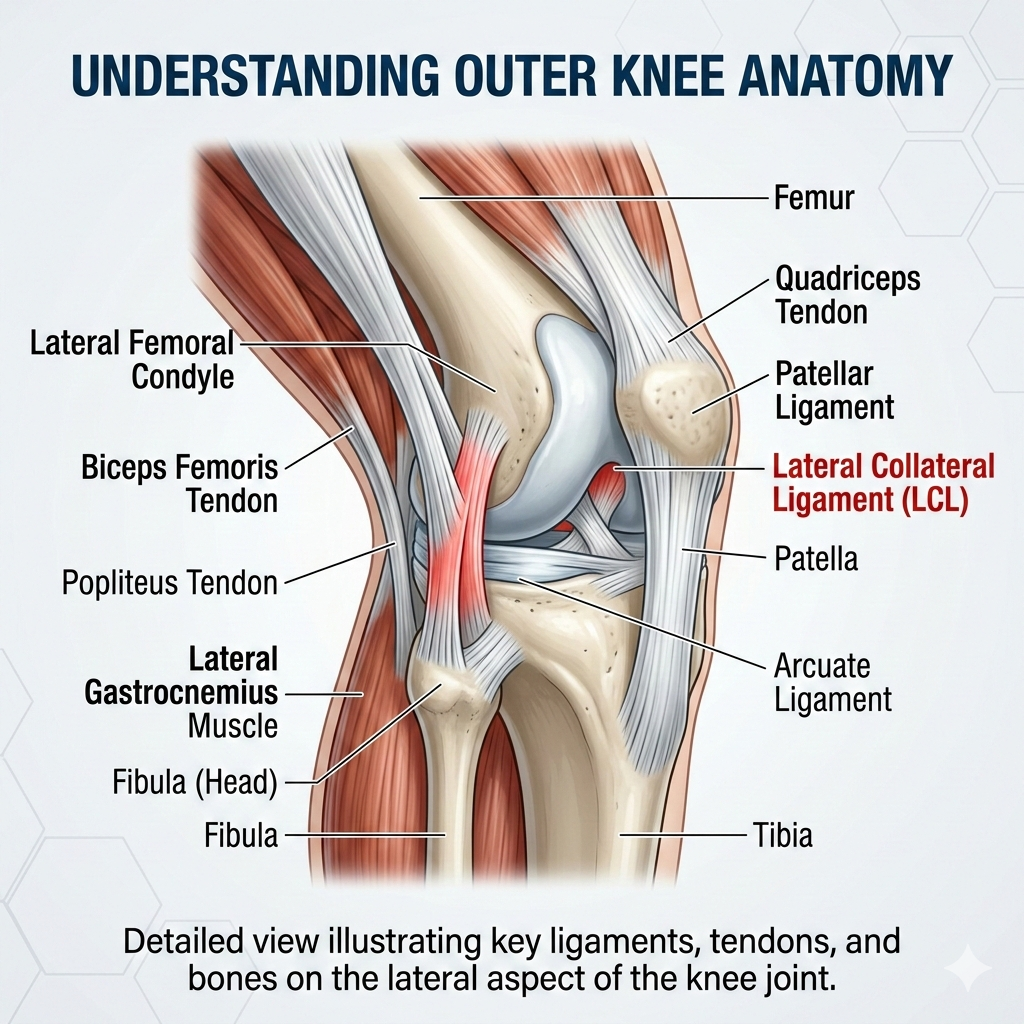
The outer knee is a complex system composed of bones, tendons, ligaments, and nerves that work together to provide motion and stability. Pain outside of the knee may result in any disruption. Most often affected are the iliotibial band, lateral collateral ligament, and meniscus; injuries to these regions usually lead to lateral pain that requires medical attention.
Common Causes of Pain Outside of the Knee
The causes of lateral knee pain usually relate to the soft tissues and cartilage along the outer joint line. A quick look at outer knee anatomy helps. The lateral meniscus cushions the joint. The lateral collateral ligament stabilises it from the side. The iliotibial band runs down from the hip and attaches near the outer knee. When any of these tissues feels stress, pain shows up.
Iliotibial Band Syndrome (IT Band Syndrome)
IT band syndrome is one of the most frequent reasons for lateral knee pain. The iliotibial band is a thick tissue strip along the outer thigh. When it tightens or rubs excessively near the knee, irritation follows. People who walk long distances, run, or cycle often describe this pattern. Pain builds during activity and eases with rest. Going downstairs may trigger a sharp outer knee ache. There is usually no major swelling, just persistent discomfort.
Lateral Collateral Ligament (LCL) Injury

An LCL injury affects the ligament that keeps the knee from bending outward. A sudden twist, a side impact, or an awkward landing can stretch or tear it. A mild strain may cause local tenderness. A lateral collateral ligament tear can bring instability and difficulty putting weight on the leg.
Lateral Meniscus Tear
A Lateral Meniscus Tear involves damage to the cartilage cushion between the thigh bone and shin bone. This cartilage absorbs shock during movement. A simple twist while standing up can lead to a tear. Many people with a meniscus tear describe catching or locking inside the knee. Squatting may become painful. Swelling may appear later rather than immediately.
Osteoarthritis of the Lateral Compartment
Not all outer knee pain comes from injury. In some cases, cartilage wear affects the outer compartment. This type of knee osteoarthritis develops over time. Pain builds slowly, and it feels worse after long walks or prolonged standing. Morning stiffness often improves after a few minutes of movement.
Symptoms of Pain Outside of Knee (Lateral Knee Pain) - Warning Signs to Watch
Pain Outside of Knee (Lateral knee pain) does not look the same for everyone; some feel a sharp edge along the outer joint line, while others describe a dull ache that comes and goes. Tenderness when pressing the outer knee is common. Bending fully may feel restricted. Clicking sounds sometimes accompany a meniscus problem. If the knee feels unstable or gives way, ligament involvement becomes more likely.
How is Lateral Knee Pain Diagnosed?
Diagnosis begins with conversation. Activity patterns, recent strain, and timing of pain all provide clues.
Physical Examination Tests
A proper knee physical exam tells a lot. The doctor checks alignment, joint movement, and stability. Pressing along the outer joint line may reproduce pain linked to a Lateral Meniscus Tear. Stress tests reveal possible LCL injury. Specific movements can highlight IT band syndrome.
Imaging Tests: X-Ray, MRI & Ultrasound
A knee X-ray shows bone alignment and arthritic changes. It does not show ligaments or cartilage clearly.
MRI scans provide details of soft tissues. They confirm a meniscus tear or lateral collateral ligament tear when needed. Imaging supports the findings from the physical exam rather than replacing it.
Professional Knee Pain Treatment Options
Outer knee pain can be treated depending on the cause. First-line knee pain treatments are non-surgical and involve physiotherapy, rest, bracing, and anti-inflammatory medication. Persistent cases may also be advised to use injections, nerve blocks, or regenerative treatments. Severe cases of meniscus or ligament injury lead to surgery. The best method to restore the knee and long-term health is by consulting a doctor to make the right diagnosis and the appropriate treatment plan.
Conservative Treatments - RICE Method
Rest reduces irritation, ice helps control inflammation, compression offers support, and elevation limits fluid buildup. These measures often form the starting point of lateral knee pain treatment. Activity adjustments also matter. Deep squats and repetitive downhill walking may need a pause.
Physical Therapy & Exercises
Targeted lateral knee pain exercise programmes focus on hip and thigh strength. Weak hip muscles often increase the load on the outer knee. Stretching the iliotibial band supports recovery in IT band syndrome. Stability work helps with mild LCL injuries. For osteoarthritis, controlled strengthening improves joint support without overload. Exercises should match the diagnosis. Copying routines without guidance may irritate the joint further.
Medications for Outer Knee Pain Relief
Short courses of anti-inflammatory medication reduce pain and swelling in many cases. Doctors decide based on overall health. Some people may require injections for joint inflammation. The aim remains simple: reduce pain while tissues recover. Those searching for knee pain treatment in Bangalore often benefit from a structured evaluation from Alleviate Pain Clinic before choosing advanced options.
How to Avoid Pain Outside of The Knee?
Small habits protect the knee; supportive footwear maintains alignment, a gradual increase in activity prevents overload, and balanced strength across the hips and thighs reduces strain on the outer joint.
Stretching after activity keeps tissues flexible while weight control lowers stress in cases of knee osteoarthritis.
When to See a Doctor for Outer Knee Pain?
Questions about when to see a doctor for knee pain are common. Mild soreness that improves within a few days may not need urgent care. Medical evaluation becomes important if pain persists, swelling increases, the knee locks, or weight bearing feels unstable. Sudden side impact injuries should also be assessed.
Why Choose Alleviate Pain Clinic for Knee Pain Treatment?
Daily life feels different when pain outside of the knee stays present. Simple tasks such as climbing stairs or getting up from the floor become uncomfortable. At Alleviate Pain Clinic, assessment focuses on movement, joint stability, and imaging correlation. The approach stays practical. Treatment decisions follow diagnosis rather than guesswork. People looking for knee osteoarthritis without surgery usually want clarity over the cause of the pain, and our experts maintain a clear, transparent conversation as a part of the structured process. A clear explanation of the cause and realistic treatment options makes that possible.
Conclusion
Pain on the outside of the knee can result from a variety of underlying causes, ranging from overuse injuries and structural issues to systemic conditions like arthritis. We at Alleviate , knee pain clinic in bangalore , believe in a thorough clinical and radiological evaluation leading to an accurate diagnosis and appropriate treatment plan for managing and alleviating the discomfort associated with outer knee pain. If you or someone you know experiences persistent knee pain, it’s essential to seek medical advice from a qualified healthcare professional. Early intervention and a tailored treatment plan can often lead to successful outcomes, allowing individuals to regain mobility and lead a pain-free life.
As with any medical condition, the information provided in this article is for general informational purposes and should not be used as a substitute for professional medical advice. Always consult a healthcare provider for a comprehensive evaluation and personalized treatment recommendation
Frequently Asked Questions (FAQs)
Pain on the outside of the knee while walking can result from overuse, ligament strain, or irritation of the tendon on the outside of the knee, especially the iliotibial band (ITB). Walking places repetitive stress on these structures, leading to inflammation or microtears. Conditions such as iliotibial band syndrome, lateral meniscus injury, or arthritis often contribute, making clinical assessment essential for proper diagnosis and treatment.
Common causes of lateral knee pain without swelling include IT band syndrome, mild LCL strain, early meniscus irritation, or muscle imbalance around the hip and thigh.
Experiencing pain outside of the knee, with no swelling, is commonly linked to iliotibial band syndrome (ITBS), early ligament strain, or nerve irritation. Unlike traumatic injuries that produce visible swelling, these conditions primarily involve soft tissue friction or irritation. Overuse, poor biomechanics, and muscular imbalances often worsen symptoms. Identifying triggers and starting early rehabilitation, stretching, and physiotherapy can help relieve discomfort and prevent progression to more severe knee complications.
The iliotibial band runs along the outer knee and often relates to pain on the outside of the knee, especially in runners and cyclists.The main tendon on the outside of the knee is part of the iliotibial band (ITB), a thick connective tissue that extends from the hip to the shinbone. The ITB stabilizes the knee during walking, running, and stair climbing. Excessive friction between the ITB and bony structures can irritate, resulting in iliotibial band syndrome. This tendon’s function is crucial for lateral knee stability and overall lower limb biomechanics.
The ligament on the outside of the knee is the lateral collateral ligament (LCL). It connects the femur to the fibula and plays an important role in resisting excessive side-to-side movement. Injury to the LCL often occurs from sudden impact, twisting, or sports activity. Symptoms include localized pain, instability, and difficulty bearing weight. A clinical examination and imaging are usually required to confirm the diagnosis and determine the most effective treatment.
Yes, iliotibial band syndrome (ITBS) can sometimes cause pain behind the outer knee. While ITBS typically produces lateral knee discomfort, the tight ITB can alter biomechanics and irritate surrounding structures, leading to pain felt toward the back of the knee joint. This discomfort is usually worse with running, walking downhill, or repetitive flexion-extension. Stretching, strengthening, and physiotherapy are effective approaches to reduce symptoms and restore normal knee function.
The right lateral knee pain treatment depends onthe cause. Rest, guided exercise, and medical evaluation often form the base approach.
Seek care if pain persists, worsens, causes instability, or limits weight bearing. This answers concerns about when to see a doctor for knee pain.
Modified lateral knee pain exercise under supervision may help. High-impact activity should pause until pain reduces.
For IT band syndrome, gentle iliotibial band and hip stretches, combined with hip strengthening, support recovery. Guidance from a therapist is advisable.


